
May 22, 2026
For Australian beef producers, a cattle crush is not just another piece of yard equipment. It is the centre of the entire cattle handling operation. Whether you are pregnancy testing breeders in Queensland, processing feeder cattle in NSW, or working large mobs in the NT, the right cattle crush affects everything from labour efficiency and cattle flow to operator safety and long-term maintenance costs.
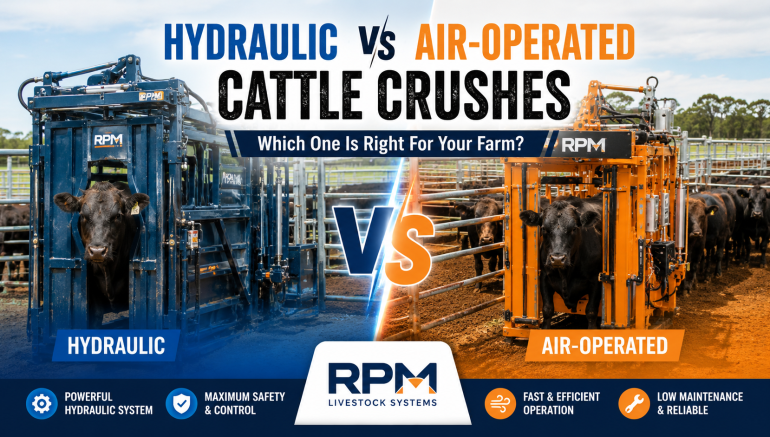
Many producers upgrading their yards today are weighing up one key question: Should you choose a hydraulic cattle crush or an air-operated cattle crush?
The answer depends on your herd size, labour availability, processing frequency, budget, and handling requirements.
In this guide, we break down the differences between hydraulic and air-operated cattle crushes, where each system performs best, and what Australian beef producers should consider before investing.
RPM Livestock Equipment has spent more than 30 years building heavy-duty cattle handling equipment for Australian conditions, with models including the Ultimate, Allrounder, Innovator, and Ultimate Air Crush designed specifically for commercial beef operations.
Why Choosing the Right Cattle Crush Matters
A poorly designed crush slows processing, increases stress on cattle, creates safety risks for operators, and often leads to higher labour demands. A well-designed crush does the opposite.
The right system can help producers:
- Improve cattle flow
- Reduce processing time
- Lower labour requirements
- Improve operator safety
- Reduce stress on cattle
- Increase throughput during busy processing periods
- Improve access for veterinary treatments
- Reduce long-term wear and maintenance
For many Australian beef operations, labour availability has become a major issue. Equipment that allows fewer people to process cattle safely and efficiently is becoming increasingly valuable. That is one reason air-operated cattle handling systems are gaining traction across larger commercial operations and feedlots.
Understanding Hydraulic Cattle Crushes
Hydraulic cattle crushes use hydraulic systems to operate the headbail and squeeze functions. Rather than relying on manual ratchet systems, hydraulic pressure allows smooth, controlled operation with reduced physical effort. .
Hydraulic systems are widely used across Australian cattle operations because they offer a strong balance between affordability, reliability, and handling efficiency
RPM’s hydraulic crush range includes the:
- Ultimate Crush
- Allrounder Crush
- Innovator Crush
Each is built using heavy-duty galvanised steel and designed for Australian beef production systems.
Benefits of Hydraulic Cattle Crushes
1. Reduced Physical Strain
Traditional ratchet headbails can be physically demanding, especially during long processing days. Hydraulic systems reduce operator fatigue significantly.
RPM notes that hydraulic headbails:
- Operate faster and quieter
- Reduce physical strain
- Improve control over different cattle sizes
- Allow safer operation for smaller or less experienced staff
For family farms or operations with limited labour, this can make a major difference during pregnancy testing, vaccinations, tagging, and drafting work.
2. Reliable for a Wide Range of Operations
Hydraulic crushes suit:
- Family farms
- Breeder operations
- Commercial beef producers
- Backgrounding operations
- Feedlots
The flexibility of hydraulic systems makes them one of the most popular choices in Australian cattle yards. For example: The RPM Innovator suits smaller to medium producers looking for durability without premium pricing.
The RPM Allrounder is designed as a commercial workhorse suitable for operations of various sizes. The RPM Ultimate is built for demanding feedlot and large-scale commercial applications.
3. Lower Initial Investment
Hydraulic crushes generally require a lower upfront investment than fully pneumatic air-operated systems. For producers upgrading older yards, hydraulic crushes often provide the best balance between:
- Operational efficiency
- Cattle safety
- Durability
- Cost-effectiveness
This makes them attractive for producers wanting long-term reliability without stepping into a fully automated handling setup.
4. Proven Technology
Hydraulic cattle crushes have been used successfully across Australian cattle operations for decades. RPM’s Ultimate and Allrounder crushes have both been trusted by beef producers across Australia for more than three decades now.
That proven track record matters when equipment is expected to operate reliably in tough environments year after year.
When a Hydraulic Cattle Crush Makes Sense?
A hydraulic crush is often the right choice if:
- You run a small to medium beef operation
- Your processing days are periodic rather than daily
- You want lower upfront costs
- You need strong functionality without full automation
- You want proven reliability with manageable maintenance requirements
- Your yard setup does not currently include compressed air systems
For many Australian beef producers, hydraulic systems remain the practical middle ground between manual handling and full pneumatic automation.
Understanding Air-Operated Cattle Crushes
Air-operated cattle crushes use pneumatic systems powered by compressed air. These systems allow operators to control squeeze functions, gates, and headbails quickly and smoothly using pneumatic cylinders and control panels.
RPM’s Ultimate Air Crush is specifically designed for:
- Large commercial beef operations
- Feedlots
- Producers seeking low-stress cattle handling
- Operations wanting reduced labour requirements
Benefits of Air-Operated Cattle Crushes
1. Faster Processing Speeds
In high-throughput operations, speed matters.
Air-operated crushes allow quicker:
- Headbail operation
- Squeeze adjustments
- Cattle release
- Drafting movement
This becomes particularly valuable during:
- Induction processing
- Pregnancy testing
- Vaccinations
- NLIS work
- Large-scale drafting days
For producers processing hundreds or thousands of head regularly, small time savings per animal quickly add up.
2. Reduced Labour Requirements
One of the biggest advantages of pneumatic systems is labour efficiency.
RPM states the Ultimate Air Crush is designed to:
- Save time
- Reduce labour costs
- Require fewer staff to manage workflow
In an environment where skilled farm labour is increasingly difficult to source, labour-saving equipment becomes a long-term operational advantage.
3. Low-Stress Cattle Handling
Quiet and smooth operation helps reduce cattle stress.
Air-operated systems minimise:
- Sudden impacts
- Loud ratchet noise
- Abrupt handling movements
Calmer cattle generally mean:
- Safer operators
- Smoother flow
- Less bruising
- Reduced stress during processing
RPM specifically describes the Ultimate Air Crush as a silent crush with strong squeeze capability designed for low-stress cattle handling.
4. Improved Operator Safety
Air systems reduce the physical handling involved in operating the crush.
This lowers:
- Repetitive strain
- Manual force requirements
- Injury risk during busy processing days
Safety becomes increasingly important for:
- Family-run operations
- Ageing producers
- Stations operating with smaller crews
- Businesses focused on WHS compliance
5. Better for Large Commercial Operations
Air-operated crushes are particularly effective in:
- Feedlots
- Large breeder operations
- Commercial processing systems
- High-volume cattle yards
If cattle are moving through the yards frequently, the efficiency gains can justify the higher upfront investment
When an Air-Operated Crush Makes Sense
An air-operated crush is often the best option if:
- You process cattle regularly
- You run larger herd numbers
- Labour efficiency is a major priority
- Operator safety is a key concern
- You already use pneumatic systems in your yards
- You want faster cattle throughput
- You are building a modern low-stress handling facility
For producers planning long-term infrastructure upgrades, pneumatic systems can provide substantial operational benefits over time.
Hydraulic vs Air-Operated Crushes: Side-by-Side Comparison
| Feature | Hydraulic Crush | Air-Operated Crush |
|---|---|---|
| Upfront Cost | Lower | Higher |
| Labour Efficiency | Good | Excellent |
| Processing Speed | Moderate to High | High |
| Operator Fatigue | Reduced | Minimal |
| Noise Levels | Quiet | Very Quiet |
| Maintenance Complexity | Moderate | Higher |
| Best For | Small to large operations | Large commercial operations |
| Infrastructure Needs | Minimal | Requires air system |
| Cattle Stress Reduction | Good | Excellent |
| Automation Potential | Moderate | High |
Choosing the Right RPM Cattle Crush
RPM Innovator Crush
Best suited for:
- Small to medium beef producers
- Family farms
- Budget-conscious upgrades
The Innovator is designed as an entry-level crush without compromising on Australian-made quality.
Ideal if you want:
- Durability
- Hydraulic handling
- Strong safety features
- Lower investment costs
RPM Allrounder Crush
Best suited for:
- Commercial beef operations
- Producers wanting versatility
- Medium to large herds
The Allrounder is RPM’s most popular commercial crush and balances:
- Hydraulic efficiency
- Heavy-duty durability
- Smooth cattle handling
- Operational flexibility
This model suits many Australian beef operations looking for long-term value.
RPM Ultimate Crush
Best suited for:
- Feedlots
- Larger stations
- Demanding commercial operations
The Ultimate is designed for high-volume environments where durability and access matter.
Features such as:
- Spey gates
- Injection gates
- Parallel squeeze
heavy-duty construction make it suitable for intensive processing work.
RPM Ultimate Air Crush
Best suited for:
- Large-scale commercial producers
- Feedlots
- Low-stress cattle handling systems
- Labour-conscious operations
The Ultimate Air Crush combines pneumatic operation with RPM’s heavy-duty construction and safety-focused design. For producers wanting maximum efficiency and reduced manual handling, it represents the premium end of cattle handling systems.
Other Factors to Consider Before Buying
- Herd Size
- Larger herd numbers generally justify higher investment in automated or pneumatic systems.
- Smaller operations may see better ROI from hydraulic systems.
Frequency of Use
Ask yourself:
- Are cattle processed weekly?
- Monthly?
- Seasonally?
The more often the crush is used, the more valuable labour-saving features become.
Labour Availability
If skilled labour is difficult to source, automation and reduced manual handling become increasingly important.
Yard Layout
Your crush should integrate smoothly with:
- Races
- Drafting systems
- Loading ramps
- Forcing pens
- Walkways
RPM also provides custom cattle yard designs and free draughtsman consultations for producers planning complete yard upgrades.
Safety Requirements
Modern cattle handling systems should improve safety for:
- Operators
- Livestock
- Contractors
- Veterinarians
Features like:
- Parallel squeeze systems
- Vet access
- Anti-backing systems
quiet operation all contribute to safer cattle handling outcomes.
Why Australian-Made Equipment Matters
Australian cattle operations place unique demands on equipment.
Dust, heat, heavy cattle, remote locations, and long operating hours all test the durability of cattle handling systems. RPM manufactures its equipment in Australia using heavy-duty steel designed for local conditions.
For many producers, local manufacturing also means:
- Better parts availability
- Easier support
- Equipment designed for Australian cattle systems
- Confidence in long-term durability
Final Thoughts
Choosing the right cattle crush is ultimately about matching the equipment to your operation. For many beef producers, hydraulic crushes remain the ideal combination of:
- Reliability
- Affordability
- Durability
- Operational efficiency
For larger operations focused on labour reduction, speed, and low-stress cattle handling, air-operated crushes offer significant long-term advantages. The key is investing in equipment built for the realities of Australian beef production.
RPM’s range of cattle crushes gives producers options ranging from practical entry-level systems through to premium pneumatic handling solutions designed for large commercial yards.
Frequently Asked Questions
What is the best cattle crush for beef producers in Australia?
The best cattle crush depends on herd size, processing frequency, labour availability, and budget. Hydraulic crushes suit many commercial beef operations, while air-operated crushes are ideal for high-throughput yards and feedlots.
Are air-operated cattle crushes worth the investment?
For producers processing cattle regularly, air-operated crushes can improve labour efficiency, reduce operator fatigue, and increase cattle throughput, making them a strong long-term investment.
What is the difference between hydraulic and pneumatic cattle crushes?
Hydraulic crushes use hydraulic systems for squeeze and headbail operation, while pneumatic crushes use compressed air systems for faster, quieter, and more automated handling.
Which RPM cattle crush is best for small to medium producers?
The RPM Innovator is designed specifically for small to medium beef producers wanting reliable Australian-made equipment without premium pricing.
Why is low-stress cattle handling important?
Low-stress handling improves cattle flow, reduces bruising and injury risk, and creates safer working conditions for operators during processing.